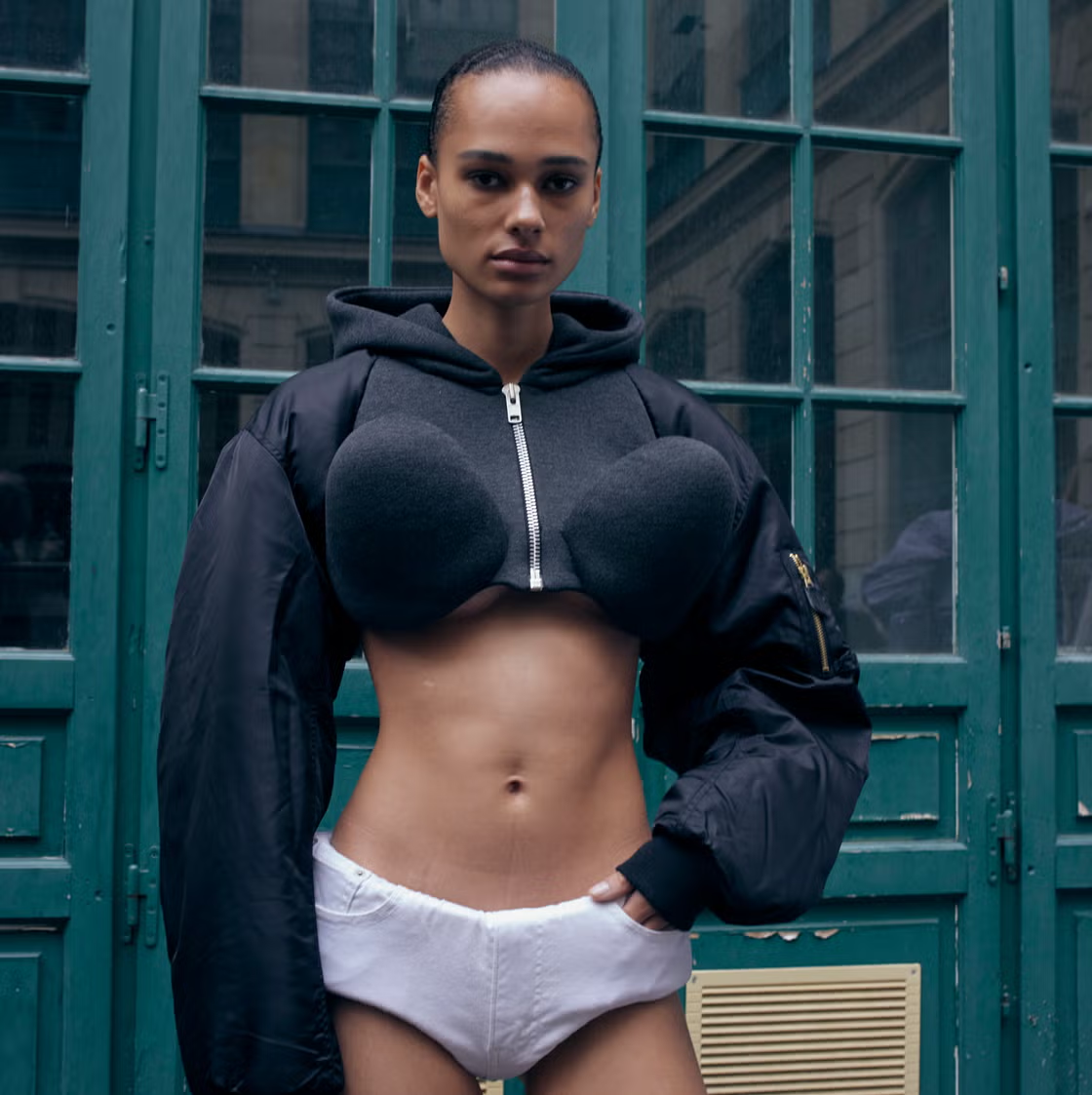
In 2024, the push-up padded bra seems to belong to a bygone era, when women were encouraged to embrace a sexier version of themselves. However, even though times have changed, the pressure to conform to beauty standards persists. The current trend seems to be moving away from old ideals toward a broader acceptance of natural shapes. Yet, recently, padding has made a comeback, but in a completely unprecedented form.
This evolution began with Claire Sullivan's controversial creation for Addison Rae at the VMAs, a bra-shaped top with breast cushions adorned with feathers, defying the conventions of traditional beauty. Then, at the Duran Lantink show in Paris, the winner of the LVMH Karl Lagerfeld Prize presented looks that were both lumpy and bumpy. Oversized padded bra-shaped tops, striped bodysuits with extra padding at the joints, evoking a kind of flotation device, gave models an otherworldly appearance, but not in the usual glamorous sense.
These extreme silhouettes have become Lantink's signature, offering an avant-garde aesthetic that could redefine the trend. Wearing a piece by Duran Lantink can make a person look like a linebacker with inflated shoulders, without pants, which stands out in the fashion world. Celebrities such as Troye Sivan, Demi Moore, and Naomi Campbell have recently sported his creations, which manage to present familiar figures in a surreal light, making even the most recognisable faces unrecognisable.
Perhaps the simple act of wearing such an unusual piece requires a level of confidence that makes it irresistible. In any case, Duran Lantink, although relatively new on the scene, seems destined to shake up the fashion landscape with his funky aesthetic that could well establish itself in the seasons to come.
The LVMH Karl Lagerfeld Prize context
The LVMH Karl Lagerfeld Prize, awarded annually by the LVMH luxury group, has become one of the most prestigious awards for emerging designers. Named after the late creative director who defined Chanel for nearly three decades, the prize carries with it a €200,000 grant and a year of mentorship from LVMH's design teams. Past recipients have included some of the most interesting designers working today, including Thebe Magugu, Grace Wales Bonner, and Nensi Dojaka.
Duran Lantink won the prize in 2023, and the recognition has catapulted his work into the mainstream in a way that his previous underground following could not. His signature — the use of extreme padding, often in unexpected places — was already gaining attention within fashion circles. But the LVMH endorsement gave it the kind of legitimacy that opens doors to red carpet dressing, magazine covers, and collaborations with established brands.
Lantink's approach to fashion has always been about subversion. Born in the Netherlands, he trained at the Amsterdam Fashion Institute and worked under a major fashion designer before launching his own label. His collections are not built on the traditional fashion cycle of seasonal trends; instead, he creates pieces that respond to specific moments, often recycling and reimagining existing garments rather than producing new ones from scratch.
The aesthetic of padded surrealism
Lantink's padded pieces operate on multiple levels. On the surface, they are visually striking — impossible silhouettes that distort the natural shape of the body in ways that are simultaneously humorous and unsettling. But underneath the visual shock is a more serious commentary on the relationship between fashion and the body.
By exaggerating and distorting the body's natural curves, Lantink's work exposes the absurdity of the beauty standards that fashion has historically reinforced. The padded bra of the 1990s was meant to enhance a particular kind of femininity; Lantink's padded bra tops exaggerate that enhancement to a degree where it becomes impossible to take seriously. In doing so, he invites the viewer to question why those beauty standards were ever considered desirable.
The pieces also function as a kind of armour. The exaggerated silhouettes create distance between the wearer and the viewer, both literally (by adding bulk) and figuratively (by signalling a refusal to conform). For the wearer, this can be empowering: the clothes make a statement on their behalf, without requiring the wearer to perform any particular kind of femininity or sexuality.
The Claire Sullivan origin
The earlier mention of Claire Sullivan's work for Addison Rae deserves its own consideration. Sullivan, a Los Angeles-based designer known for her playful and provocative designs, created a bra-shaped top with feather-adorned breast cushions for Rae to wear at the 2022 VMAs. The piece was instantly viral — half the internet loved it, the other half was baffled — and it set the stage for Lantink's more extreme work to be received as part of a broader trend rather than an isolated oddity.
Sullivan's approach is different from Lantink's. Where Lantink's padding tends toward architectural exaggeration, Sullivan's is more decorative — the feathers, sequins, and bright colours make her pieces feel more like costume or art object than clothing. But both designers share a willingness to use the body as a canvas for visual statements that go beyond conventional fashion.
The Rae moment was also notable for who she is: a social media native who rose to fame on TikTok, with a fan base that's predominantly Gen Z. Her willingness to wear Sullivan's creation signalled an openness in younger audiences to fashion that doesn't conform to traditional aesthetics. The reception of the look — enthusiastic engagement, debate, memes — was a sign that there was an audience for this kind of fashion experimentation.
Why extreme padding works now
The current moment in fashion is particularly receptive to the kind of exaggerated silhouettes Lantink creates. The industry has spent the past decade moving away from the hyper-sexualised, body-conscious looks of the 2010s. The push-up bra, the bandage dress, the bodycon silhouette — these are styles associated with a particular kind of glamour that has fallen out of fashion's favour.
In their place has come a more diverse range of silhouettes. Designers from Comme des Garçons to Molly Goddard to Simone Rocha have built reputations on pieces that distort, exaggerate, or otherwise play with the body's natural shape. The padded pieces Lantink creates fit into this lineage.
There's also a generational shift in how fashion is consumed. The algorithm-driven social media landscape rewards pieces that are visually distinctive and immediately recognisable. A padded bra-shaped top reads as content in a way that a simple slip dress does not. For designers trying to break through the noise, exaggerated silhouettes offer a way to be seen.
The celebrity adopters
The list of celebrities who have worn Lantink's pieces reads like a who's who of fashion's more adventurous dressers. Troye Sivan has been a particularly visible adopter, wearing Lantink pieces in music videos and on red carpets. His willingness to wear pieces that distort his silhouette has been part of a broader conversation about masculinity and fashion, and his embrace of Lantink's work has helped introduce the designer to a younger, queer audience.
Demi Moore's appearance in Lantink was particularly striking. An actress of her stature, with decades of red carpet dressing behind her, choosing to wear a piece that made her look deliberately strange was a clear statement. It signalled that even the most established Hollywood figures were willing to take fashion risks.
Naomi Campbell, the original supermodel, has also embraced Lantink's work. Her appearance in his pieces reinforces the surrealist framing: a face that has defined fashion for forty years, wearing a silhouette that makes her almost unrecognisable. The visual impact is part commentary on fashion's obsession with celebrity, part celebration of fashion's ability to surprise.
The question of wearability
The most common question about Lantink's work is whether it's wearable in any practical sense. The padded pieces are not designed for everyday wear; they are designed for specific moments — a red carpet, a magazine editorial, a music video — where the visual impact is the point.
But this is, in some ways, the point. Fashion has always had a gap between its everyday wear and its most avant-garde expressions. The runway shows at Paris and Milan present clothes that 99% of the audience will never wear. The value of these pieces is in their ability to expand the vocabulary of fashion, to suggest new possibilities for what clothing can be.
Lantink's padded pieces do this in a particularly direct way. They make visible the construction of femininity that fashion has traditionally concealed. They take the padding that has long been hidden in bras and foundation garments and bring it to the surface. The result is at once a critique and a celebration of the artificiality that underpins much of what fashion sells.
The future of padded fashion
Whether Lantink's extreme padding becomes a lasting trend or remains a niche aesthetic is one of the more interesting questions in current fashion. The signals are mixed. On one hand, the LVMH endorsement and celebrity adoption suggest the work has staying power. On the other hand, the extreme nature of the pieces limits how broadly they can be worn.
What's more certain is that Lantink's work has opened a conversation that will continue to influence designers. The padded pieces have made it acceptable — even desirable — to use the body as a starting point for visual experimentation rather than a constraint to be respected. This shift has implications beyond the specific silhouettes Lantink creates.
Other designers are already responding. Pieces that exaggerate the shoulders, the hips, the waist, the chest — all of these were present in the recent collections shown at Paris and Milan. Whether they credit Lantink directly or not, they exist in a context that his work has helped create.
The fashion industry is famously cyclical, but some moments mark real shifts in how designers and audiences think about clothing. Lantink's extreme padding may turn out to be one of those shifts. Even if the specific silhouettes fade, the permission to use the body in unexpected ways will likely remain.
The deeper resonance of surrealist fashion
Surrealism has a long history in fashion, from Elsa Schiaparelli's collaborations with Salvador Dalí in the 1930s to Hussein Chalayan's more conceptual work in the 2000s. What Lantink adds to this tradition is a particular focus on the body itself. Where previous surrealist designers used imagery and objects to create dreamlike effects, Lantink distorts the body itself, turning the wearer into the surrealist object.
This focus on the body as a site of transformation is particularly resonant in the current moment. Conversations about gender, identity, and the politics of appearance are more public than ever. Clothing that distorts the body's natural shape is one way of participating in these conversations — of suggesting that the body's "natural" shape is itself a construction that can be questioned.
Lantink's work doesn't take an explicit political position, but it exists in a cultural moment where such positions are unavoidable. By making the padding visible, he invites a conversation about why we pad, who we pad for, and what it means to take that padding seriously enough to exaggerate it.